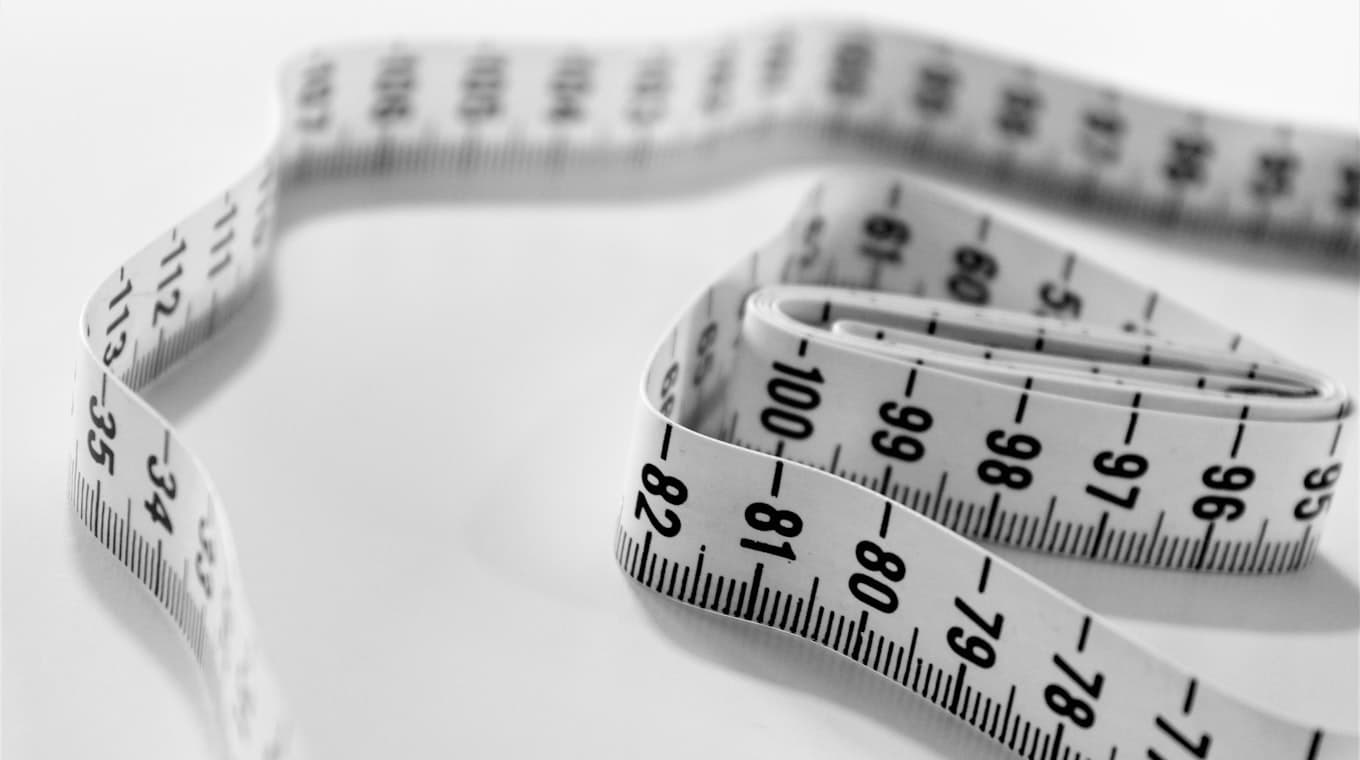
Why you're a medium in one shop and a large in the next
24 July 2026 · 5 min read · Kleerdrobe
You are a medium in one shop, a large in the next, and a 38 in a third. Nothing about you changed between the fitting rooms. This is not you being between sizes, and it is not a conspiracy — it is the predictable result of a system where nobody is required to agree on anything.
There is no mandatory clothing size standard
This is the fact that explains most of the rest. A European standard exists — EN 13402, which defines sizing by actual body measurements in centimetres — but it is entirely voluntary. Almost nobody uses it as their primary labelling.
Compare that to fibre composition, which EU law does require on the label. One of those numbers you can trust across every brand in the shop. The other is whatever the brand decided it should mean.
Body measurement versus garment measurement
The first source of confusion is that size charts measure two different things and rarely say which.
A body measurementchart tells you the size fits a person with a 96 cm chest. A garment measurementchart tells you the item itself measures 108 cm around the chest when laid flat and doubled.
The gap between those two numbers is ease— the room designed into the garment so you can move. And ease is a style decision, not a fixed quantity. An oversized shirt and a slim shirt cut for the exact same body will differ by 20 cm in the chest and both are correctly labelled medium.
This alone accounts for a huge share of sizing confusion. Two charts, both accurate, measuring different objects.
The fit model
Every brand develops its garments on a real person — a fit model — whose proportions become the reference for that brand’s entire range.
If a brand’s fit model has a long torso, every top in that range runs long. If she has narrow shoulders, every jacket does. The brand is not making a mistake; it is being internally consistent with a body that may or may not resemble yours.
This is why people find brands they “always fit” and stick to them for years. You are not loyal to the brand. You match its fit model.
Grading, and why the extremes fit worst
A garment is designed in one size and then graded up and down by applying increments — add so many centimetres to the chest, so many to the sleeve, for each step.
Bodies do not scale linearly. Going up two chest sizes does not make your arms proportionally longer. So the size the garment was designed in fits best, and accuracy degrades in both directions. If you are at the far end of a brand’s range, you are wearing the size the pattern has been stretched furthest to reach.
Size inflation is real and measurable
Labelled sizes have drifted larger over decades. A garment labelled with a given size today is generally roomier than the same label was in the 1980s. The mechanism is straightforward commercial feedback: customers respond well to fitting into a smaller number, so brands drift that way, and once a few move the rest follow to stay comparable.
The consequence is that a size label is not a measurement, and it is not stable over time either. It is closer to marketing than to metrology.
What actually works
Measure a garment you already own and love. Not your body — the garment. Lay it flat, measure the chest across the widest point under the arms, the shoulder seam to shoulder seam, the sleeve from shoulder seam to cuff, and the total length from the base of the collar. Write those four numbers down and keep them on your phone.
Then compare to product measurements rather than to size labels. You are matching object to object, which removes the fit model, the grading and the label from the equation entirely.
Read the reviews for fit comments specifically.Volume of “runs small” comments is one of the few reliable crowd-sourced signals in online clothing.
When a brand fits, note which one and why.If a brand’s medium works for you, its whole range probably will, because it is all built on the same body.
Why this matters more than it seems
Online fashion returns run at 30 to 50 percent, and fit is the dominant reason. Every one of those returns is a garment shipped twice, handled twice, and sometimes not resold at all.
It is also the mechanism behind a habit that has become normal: ordering three sizes intending to keep one. That is a rational response to a system where the label means nothing — the customer is doing the fitting room at home because the size chart could not be trusted.
Four measurements written on your phone will not fix the industry. But they will get you a long way toward buying one garment instead of three, and toward the thing that actually makes a wardrobe last: owning clothes that fit well enough that you keep reaching for them.